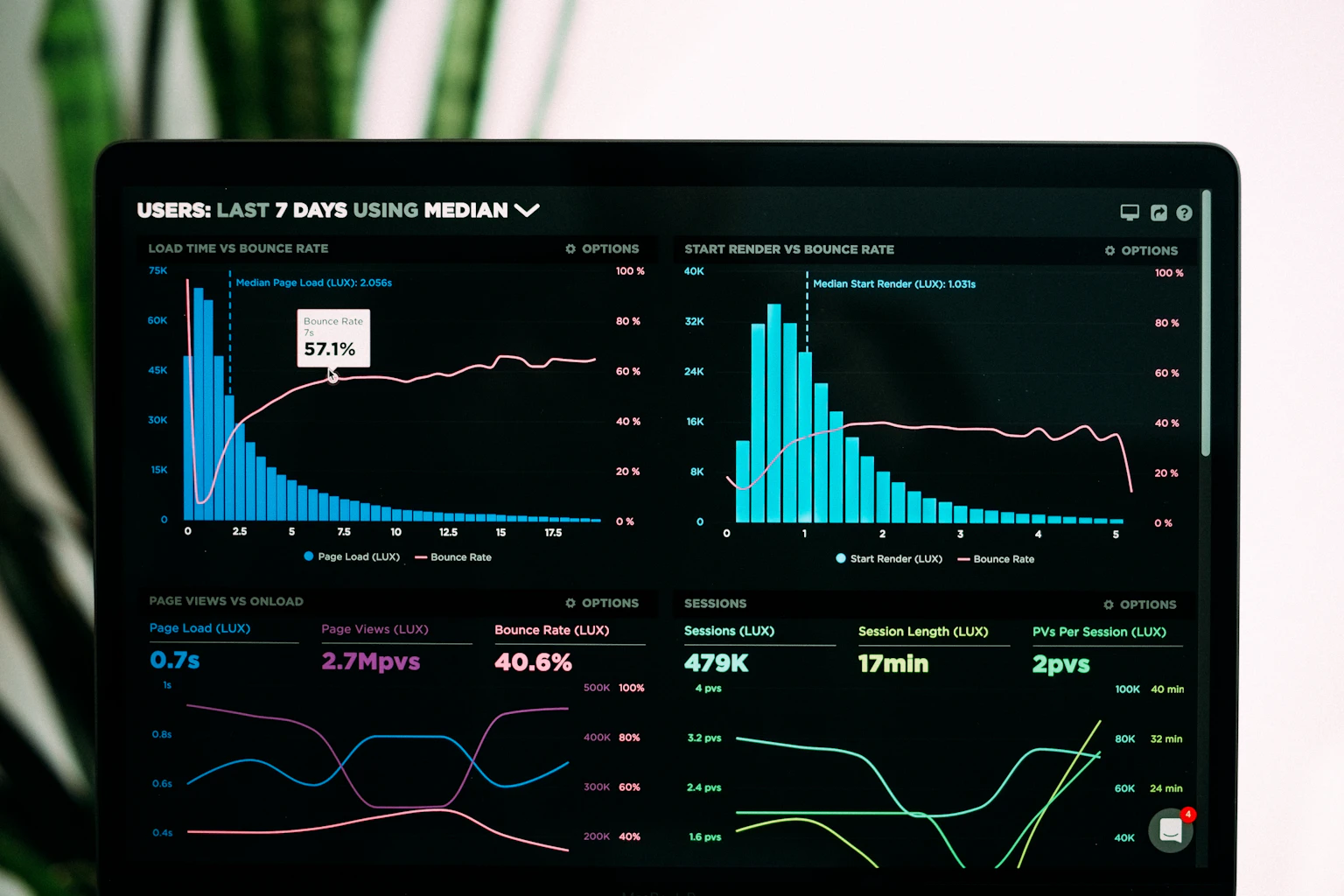
Business dashboards
Business dashboards that actually get used
Most small businesses already have the data — in the POS, the booking system, Google Ads, a spreadsheet someone updates on Fridays. The problem is not missing numbers. It is that nobody can see them in one place without exporting, copying, and hoping the version on the shared drive is current.
A business dashboard fixes that. One screen, live numbers, the metrics that matter to your floor or workshop — not a corporate BI project that sits unused after launch.
What a business dashboard is (in plain English)
A dashboard is a single web page that pulls live data from the systems you already run and shows the handful of numbers you check to know how the week is going.
Depending on your business, that might include:
- Operations — covers tonight, wait times, no-shows, jobs booked vs completed, stock below reorder level.
- Sales — today’s takings, average transaction, online vs in-store, top products, quote pipeline.
- Marketing — Google Ads spend and leads, website sessions, form fills, cost per enquiry.
- Bookings — appointments today and this week, cancellations, capacity by practitioner or lane.
- Inventory — fast movers, slow lines, supplier lead times, shrinkage flags.
For a Prahran cafe, that might be covers, labour as a percentage of sales, and weekend booking fill. For a physio clinic, appointments per practitioner and new-patient enquiries. For a trade business, quoted jobs, accepted jobs, and cash in the pipeline. Same idea, different numbers.
How dashboards help day to day
One source of truth
When the owner, floor manager, and bookkeeper all look at the same screen, arguments about “whose spreadsheet is right” stop. The dashboard reads from the systems of record — POS, bookings, ads — not from a file someone edited yesterday.
Faster decisions
Should you roster another person on Saturday? Is the Google Ads campaign paying for itself this month? Do you need to reorder before the long weekend? A good dashboard answers those in seconds, on a phone, between customers.
Less spreadsheet chasing
Weekly exports, VLOOKUP, manual copy-paste — that work adds up. Automating the pull from your POS or booking tool frees admin hours and removes the typos that skew a month’s reporting.
Spot problems early
A slow Tuesday shows up on Tuesday, not when you reconcile at month end. Cancellations climbing, ad spend with no enquiries, stockouts on a bestseller — trends are visible while you can still fix them.
Align the team
When front-of-house, back-of-house, and the owner share the same five metrics, priorities line up. Less “I didn’t know we were behind on bookings” and more “we all saw it on Monday.”
What “good” looks like for walk-in and local businesses
Dashboards built for enterprise HQ rarely work on a shop floor. For restaurants, retail, clinics, and trades across Melbourne and the rest of Australia, we aim for:
- Live numbers — refreshed on a sensible schedule (hourly, daily, or near-real-time where the source allows), with the last-updated time visible.
- Mobile-friendly — readable on a phone between appointments or at the pass. Big type, simple layout, no pinch-zoom gymnastics.
- Five to eight metrics, not fifty — the ones you would actually act on. Everything else is noise.
- Behind login when needed — revenue and payroll-adjacent data stays private. Staff see what they need; owners see the full picture.
- Plain labels — “Covers tonight” not “F&B cover count KPI”. Your team should know what they are looking at without a manual.
A dashboard nobody opens is just an expensive screenshot. Good design is dense but clear — the same discipline we use for operator-facing websites and apps.
Data sources iWizz commonly connects
Every business is different, but most SME dashboards we build pull from a mix of tools you already pay for. We do not invent integrations — we connect what you actually use:
- POS — Square, Shopify POS, Lightspeed, and similar tills for sales, items, and shifts.
- Bookings — clinic schedulers, table booking tools, swim-school enrolment systems, job-scheduling apps.
- Google Ads and Analytics — spend, clicks, conversions, and website behaviour.
- Spreadsheets — when a process still lives in Google Sheets or Excel, we can read it until it moves somewhere better.
- Accounting exports — Xero (and similar) via API or scheduled exports for revenue, expenses, and cash-flow snapshots.
- Website and CRM — form submissions, enquiry pipelines, e-commerce orders, email list growth.
If a source has an API or a reliable export, we can usually wire it in. If it does not, we are honest about workarounds — manual upload, email parsing, or fixing the upstream tool first — before promising a live feed.
How iWizz builds your dashboard
We treat dashboards as custom web tools, not off-the-shelf SaaS with fifty charts you will never use. Typical flow:
- Discovery — short workshop on how you run the week: what you check now, where the data lives, who needs to see it.
- Choose the metrics that matter — usually five to eight. We push back on vanity numbers and agree what “good” and “bad” look like.
- Design a dense, mobile-friendly UI — layout, colours, and hierarchy suited to your team, not a generic template.
- Connect sources — APIs, scheduled syncs, and error handling so a broken feed is obvious, not silent.
- Secure login — role-based access where owners, managers, and staff see appropriate slices of the data.
- Iterate — first version goes live quickly; we refine labels, add a metric, or drop one that nobody uses.
Timelines depend on how many sources and how clean the data is — a single POS plus Google Analytics is a different job to five systems and a decade of spreadsheet habits. We quote after discovery, with a fixed scope for version one.
When you might not need a dashboard yet
Honest answer: not every business is ready.
- You are still picking your POS or booking system — wiring a dashboard before the stack settles is wasted effort.
- One person runs everything and already knows the numbers by heart — a weekly five-minute check in a notebook may be enough for now.
- Your data is scattered and never reconciled — sometimes the first job is cleanup and a single system of record, not a pretty front end.
- You want “AI insights” but cannot define what you would do differently if sales dropped ten percent — start with the decision, not the dashboard.
When those blockers are gone and you are tired of reconciling spreadsheets, that is usually the right time to talk.
Talk to iWizz
iWizz builds custom business dashboards for Australian SMEs — hospitality, retail, clinics, trades, clubs, and swim schools. Studio in Prahran; clients nationwide. We are a Shopify Partner, Square Partner, and Google Workspace Partner, and we build the web tools that sit alongside those platforms.
Tell us what you would want on one screen if you could check it from your phone tomorrow. We will say straight whether a dashboard is the right next step and what it would take to build yours.