AI search · Local business
Agentic search for local business
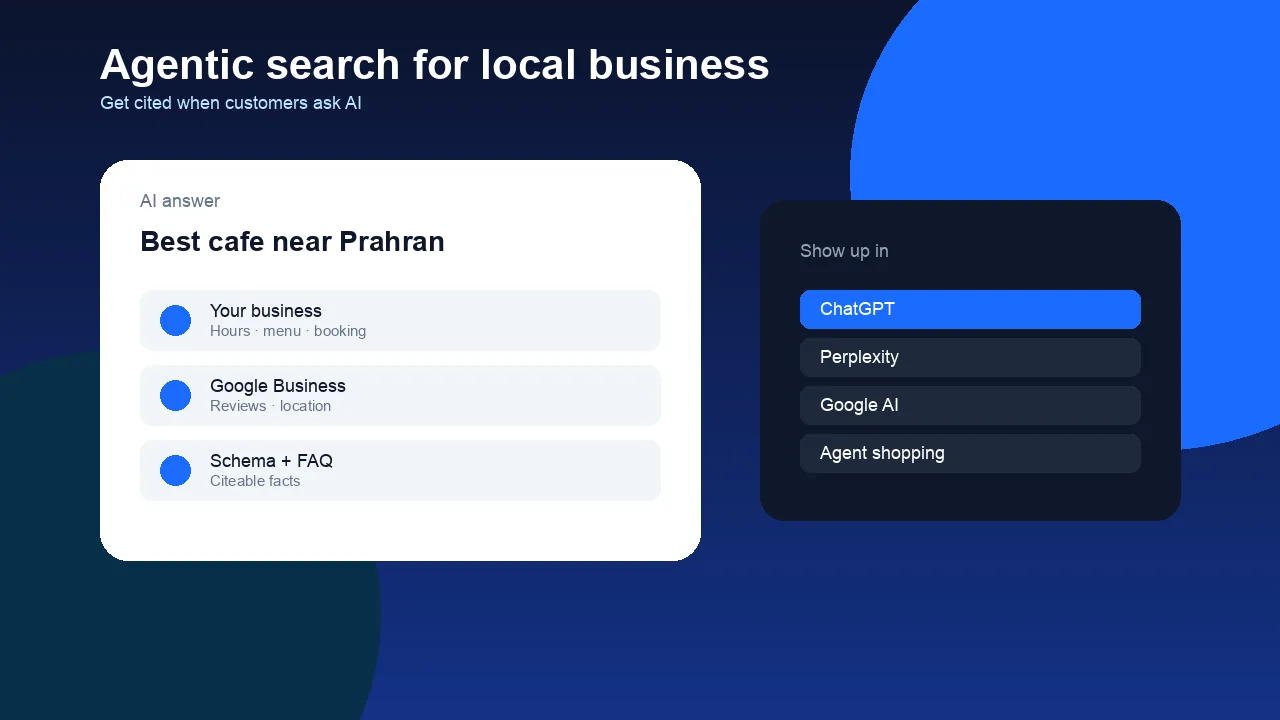
Customers still Google “near me”. They also ask ChatGPT where to eat, Perplexity who to see for a physio, Google’s AI answers which retailer stocks a product, and shopping agents whether something is in stock for pickup. Agentic search is that shift: answers and actions built from sources the models can trust — not only ten blue links.
This article is about making your business citeable and bookable in those answers. It is not about buying a ChatGPT ad that opens a chat agent — we covered paid agent campaigns in When the ad opens a conversation. Here the work is organic readiness: clear facts, structured data, and offers an AI (or a human) can use without guessing.
What “agentic search” means for a cafe, clinic, or shop
In plain terms: someone asks an AI a question, the system pulls from the open web and business data, and it may recommend you, summarise your hours, or start a booking or purchase path. For Australian SMEs that usually looks like:
- Hospitality — “best brunch in Prahran”, dietary options, waitlist or booking links.
- Clinics — what you treat, how to book, what to bring, suburb and parking.
- Retail and fashion — whether a size or colour is available, pickup vs shipping, store location.
- Trades — service area, response times, licence notes, how to request a quote.
If your site and Google Business Profile disagree, or your FAQ is vague, the model either skips you or invents a half-answer. Fixing that is the job.
Entity clarity: one business, consistent facts
AI systems (and Google) need a stable identity: legal and trading name, address, phone, hours, categories, and a short description that matches reality. Check that these match across:
- Your website footer and contact page
- Google Business Profile
- Apple Business Connect / Maps where you use them
- Social profiles and directory listings you still care about
One suburb spelling, one phone number, one set of hours. Inconsistent NAP (name, address, phone) is still one of the fastest ways to disappear from local answers.
Schema and machine-readable pages
Schema markup tells crawlers what the page is: a LocalBusiness, a Product, an FAQ, an Article. We already write about the basics in Schema markup that search engines understand. For agentic search, prioritise:
- LocalBusiness (or a more specific type) with address, geo, opening hours, and sameAs links.
- FAQPage for the questions reception answers every day.
- Product / Offer for ecommerce — price, availability, and currency that match the cart.
- Service pages for trades and clinics — what is included, service area, how to enquire.
Schema does not replace good copy. It labels facts that are already visible on the page. Invented markup that contradicts the HTML is worse than none.
FAQ and citeable answers
Write the answers your team already gives on the phone — short, specific, dated when needed (term dates, seasonal hours). Examples:
- Do you take walk-ins on Saturday?
- Is there parking / which tram?
- What does a first consult include?
- Do you offer click-and-collect same day?
- Which suburbs do you service?
Models prefer pages they can quote. A clear FAQ beats a marketing paragraph that never states the hours.
Google Business Profile and reviews
GBP remains the backbone of local discovery — including what many AI systems lean on for hours and reputation. Keep categories accurate, photos current, posts occasional but real, and review replies consistent. We cover the wider local SEO picture in How local businesses get found on Google.
Reviews should be genuine. Ask happy customers; do not invent them. Reply to negatives with facts and a path to fix — models and humans both read the tone.
Product and feed data (for retail and Shopify)
Shopping agents and AI product answers need clean catalogues: titles, GTINs where you have them, accurate stock, shipping and return policies. If you run Shopify, feed hygiene and product-page clarity are part of the same enhancement work we describe in Shopify store enhancements that actually sell.
A feed that says “in stock” when the shelf is empty will get you recommended once — and complained about forever.
Clear offers and next steps
When an AI recommends you, the next click should land on a page that can finish the job: book, call, buy, or request a quote. That means:
- One primary CTA per page (book / call / buy)
- Visible phone number on mobile
- Booking or enquiry forms that work without a desktop
- Offers stated plainly — “weekday lunch special”, “new-patient assessment”, “free measure and quote” — not vague “premium experiences”
How this differs from ChatGPT ads
When the ad opens a conversation is about paid placements inside ChatGPT that can open a business agent. This article is about the unpaid layer underneath: being findable and correctly described when someone asks an AI (or Google AI Overview) for a recommendation.
You still need Google Ads and Meta for demand you control. Agentic organic readiness sits beside that — same facts, same site, fewer contradictions.
A practical checklist for Aussie SMEs
- Align name, address, phone, and hours everywhere that matters.
- Refresh Google Business Profile categories, photos, and Q&A.
- Add or fix LocalBusiness + FAQ schema that matches visible content.
- Publish a short FAQ in plain English for your top ten questions.
- Clean product or service pages — stock, price, area, booking path.
- Ask for real reviews; reply to the ones you have.
- Test: ask ChatGPT, Perplexity, and Google the questions your customers ask — note what they get wrong, then fix the source pages.
How iWizz helps
iWizz builds and tightens the site layer local businesses need for both classic SEO and AI answers: entity consistency, schema, FAQ, Google Business Profile, review workflows, and product/feed hygiene for Shopify stores. Studio in Prahran; clients across hospitality, retail, clinics, trades, clubs, and swim schools Australia-wide.
We do not promise rankings inside ChatGPT or invent citation metrics. We make your facts clear, structured, and consistent — so when someone asks an AI about your category and suburb, your business is easy to recommend correctly.
Talk to iWizz
If you want a practical pass over your site and listings for AI and local search — not a slide deck about “the future of search” — call us. We will say what is broken, what is good enough, and what to fix first.